
 BEng(Computer Science)
School of Computing and Data Science, the University of Hong Kong
I am a final-year undergraduate studying Computer Science and Mathematics at the University of Hong Kong.
I am seeking PhD opportunities for Fall 2027.
My research lies at the intersection of multimodal generative modeling, spatial intelligence, and embodied AI. I am particularly interested in how intelligent systems can build grounded representations of dynamic 3D environments and generate coherent behaviors from multimodal signals such as language, vision, speech, and motion.
My recent work explores these questions through controllable camera motion generation from text and keyframes, as well as emotion-aware generation of human motion and speech. These projects have led me to broader questions about how generative models can understand, predict, and interact with dynamic physical environments.
Warning
Problem: The current name of your GitHub Pages repository ("Solution: Please consider renaming the repository to "
http://".
However, if the current repository name is intended, you can ignore this message by removing "{% include widgets/debug_repo_name.html %}" in index.html.
Action required
Problem: The current root path of this site is "baseurl ("_config.yml.
Solution: Please set the
baseurl in _config.yml to "Education
-
 Princeton UniversityDepartment of Computer Science
Junior Exchange StudentJan. 2025 - May. 2025 -
The University of Hong KongBEng in Computer ScienceSep. 2022 - present
Experience
-
HKU CGVU LabResearch Intern
Supervised by Prof. Taku Komura2025.5 - present -
 Rights and Interests Committee (RIC), The University of Hong KongCommittee MemberOct. 2023 - Oct. 2025
Teaching
-
COMP1117 Computer Programming26-27 Semester 1
-
COMP2113 Programming Technologies25-26 Semester 2
-
COMP1117 Computer Programming25-26 Semester 1
-
COMP2396 Object-Oriented Programming and Java24-25 Semester 1
-
COMP2113 Programming Technologies23-24 Semester 2
Honors & Awards
-
Simon K.Y. Lee Hall Award for Academic Achievements2024
-
Dean's Hounors List, Faculty of Engineering, The University of Hong Kong2023
-
Soong Ching Ling Scholarship, China Soong Ching Ling Foundation2022
Selected Publications (view all )
TKCAM: Text and Keyframe to Camera Trajectory Generation
Haozhe Yang, Zhiyang Dou, Zekai Gu, Cheng Lin, Wenping Wang, Yuan Liu, Taku Komura
Advances in Neural Information Processing Systems (NeurIPS), 2026 Poster
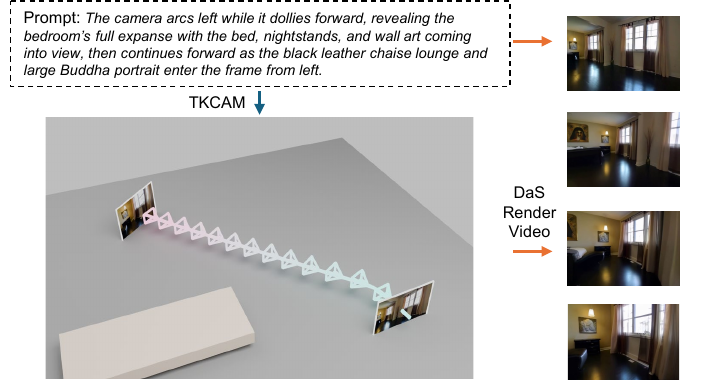
We introduce TKCAM, a text- and keyframe-conditioned camera trajectory generation framework based on generative masked modeling. Camera dynamics are formulated as continuous 12-dimensional kinematic sequences and discretized into hierarchical motion tokens via a Residual Vector Quantizer (RVQ), enabling a two-stage masked transformer to reconstruct temporally coherent trajectories from free-form text prompts and sparse RGB keyframes. TKCAM significantly surpasses recent state-of-the-art baselines on FID, text-motion matching, and retrieval metrics (R@K).
TKCAM: Text and Keyframe to Camera Trajectory Generation
Haozhe Yang, Zhiyang Dou, Zekai Gu, Cheng Lin, Wenping Wang, Yuan Liu, Taku Komura
Advances in Neural Information Processing Systems (NeurIPS), 2026 Poster
We introduce TKCAM, a text- and keyframe-conditioned camera trajectory generation framework based on generative masked modeling. Camera dynamics are formulated as continuous 12-dimensional kinematic sequences and discretized into hierarchical motion tokens via a Residual Vector Quantizer (RVQ), enabling a two-stage masked transformer to reconstruct temporally coherent trajectories from free-form text prompts and sparse RGB keyframes. TKCAM significantly surpasses recent state-of-the-art baselines on FID, text-motion matching, and retrieval metrics (R@K).